
Anti-fouling is changing and no one has a perfect replacement yet
Tighter environmental regulation is forcing the marine sector away from biocidal coatings – but the alternatives are still catching up. The result is an industry navigating real trade-offs with no clear answer in sight.
For decades, tributyltin was the gold standard. Effective, durable, and cheap, it kept hulls clean and fuel bills low. Then its environmental impact became impossible to ignore – and with the IMO ban in 2008, the industry adapted to copper-based biocides. Now those too are under pressure.
California has led restrictions on copper antifouling in recreational waters since 2020. The EU’s Biocidal Products Regulation has tightened approval criteria significantly. And major shipowners, under pressure from sustainability frameworks, are voluntarily moving faster than the law requires
The direction of travel is clear. What isn’t clear is what comes next.
The leading alternatives – foul-release coatings, silicone-based systems, and ultrasonic anti-fouling – each offer genuine advantages. But they come with real limitations that biocidal coatings don’t: higher upfront cost, speed sensitivity, and performance that varies significantly by vessel type, trade route, and docking frequency.
Foul-release coatings work on a simple principle: rather than killing organisms, they make the hull surface too slippery to hold on to. For vessels operating consistently above eight knots, the results can match or beat biocidal performance. Below that threshold, the system struggles – and slowsteaming, which has become standard practice for fuel economy, is precisely the operating profile where foul-release underperforms.
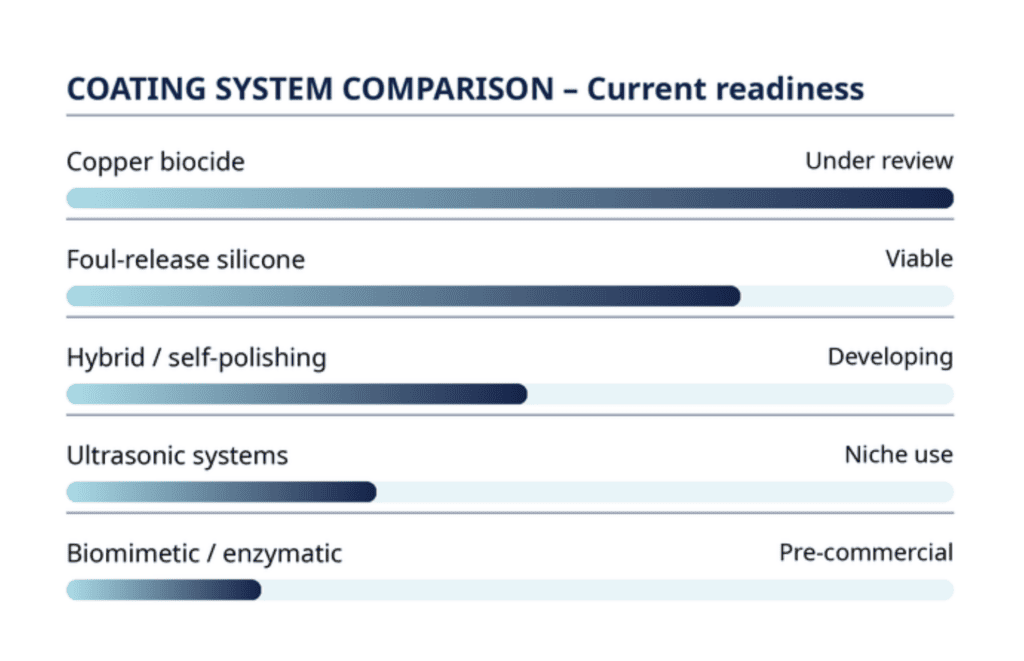
The consequence is that many yards are making decisions by elimination. Biocides are legally or reputationally difficult. Foul release doesn’t suit every vessel. Emerging technologies like biomimetic surfaces and enzymatic coatings are promising but not yet commercially proven at scale. The result is an extended period of in-between – where the best available option depends heavily on context, and applying the wrong system costs significantly more than just repainting.
The Core Tension
Regulation
Pushing away from proven biocidal systems faster than alternatives mature.
Performance
Each alternative has a vessel profile where it works – and several where it doesn’t.
Maintenance
Increased docking frequency and inspection cycles add cost back in
Decision Risk
Wrong system choice means full strip recoat – not just touch-up
What yards are doing right now: most are running biocidal systems to the end of their service life while piloting alternatives on lower-risk vessels. Few are making fleet-wide commitments. The absence of a clear market winner is itself shaping strategy.